

As someone who has spent years helping travelers and expats understand the complex world of visa insurance, I can tell you that this is one of the most confusing questions. Just last week, a client from Karachi, Pakistan called me in a panic. Her German student visa appointment was only three days away and she had purchased a generic travel insurance policy online—the same one she had used on her previous European vacations. She couldn’t understand why her documents had suddenly become “insufficient.”
The difference between Type C and Type D visa insurance isn’t just a matter of government red tape. It’s the difference between a policy that will get you into Europe and a policy that will get you rejected. More importantly, it’s about providing real protection for your real needs while you’re there.
At dotzee.eu, we’ve processed thousands of visa insurance applications in both categories and I’ve seen every possible mistake. Let me tell you exactly what you need, why you need it, and how to avoid the costly mistakes that keep visa officers busy.
🛂 Understanding the Basic Differences Between Type C and Type D Visas
First, let’s talk about visas. Insurance is attached to the visa, so if you don’t understand the basics of visas, you could end up buying the wrong insurance.
A Type C visa is also known as a “short-stay visa” or “Schengen visa.” It’s for tourist trips, business meetings, or visiting family and friends. It’s usually valid for up to 90 days in any 180-day period. Simply put, it’s the visa you get for a vacation or a short stay.
A Type D visa is called a “long-stay visa” or “national visa.” This is for those who want to stay in a European country for more than 90 days. It is usually taken by students, working professionals, or those who are moving permanently with family. Students studying in Germany, France, or the Netherlands usually take a type D visa.
Why is this difference important? Because the insurance requirements for the two visas are completely different. And it’s not just the duration that matters—it’s the nature of the coverage, the financial protection, and the legal requirements.
📝 Type C Visa Insurance: Guidelines for Tourists and Short Stays
What are the basic requirements?
The insurance for a type C visa must comply with the common conditions of the embassies of the Schengen countries. These conditions are very clear:
- Minimum coverage: 30,000 euros (approximately 8.5 million Pakistani rupees)
- Regional coverage: valid in all Schengen countries
- Risk coverage: includes medical emergencies, hospitalization, and repatriation if necessary
These are the minimum conditions that apply throughout Europe. No Schengen country accepts anything less.
Practical advice: Don’t just go for the minimum
Now let me tell you from my own experience. I have seen many people just look for cheap insurance and take out a policy that meets the minimum requirements. But this mistake can be costly.
Imagine you are in Paris and you have an accident. A day in the hospital in Europe can cost between 1,000 and 2,000 euros. 30,000 euros can be wiped out in just 15-20 days if you have to stay in the ICU.
That’s why at dotzee.eu we always recommend taking out coverage of 50,000 euros or more if possible. The difference is only a few euros, but the protection is huge.
Common mistakes people make
- I saw a case where a person took out free insurance with their credit card and thought it was enough for a visa. At the visa appointment, it turned out that it didn’t have repatriation coverage—and their application was rejected.
- Another common mistake is that people don’t take out insurance for the entire duration. If you’re going for 15 days, the insurance should be for the full 15 days, not for fewer days.
🏥 Type D Visa Insurance: Special Requirements for Long Stays
Why is Type D Visa Insurance Different?
The great thing about Type D visa insurance is that it’s not just for getting a visa—it’s a real-life necessity. When you stay in a country for more than 90 days, you become part of its healthcare system.
According to Van Broek Insurance experts, international students should consider the following:
- Pre-enrollment communication: Find out about insurance before you arrive at university. Many families are unaware that insurance is mandatory.
- Orientation program: Get complete information about insurance upon arrival at university.
- Mental health support: International students face homesickness, cultural change, and academic stress — a good insurance policy also provides mental health benefits.
For students studying in Germany, insurance is mandatory. And it’s not just for the visa—insurance is also required for university registration.
Types of Type D visa insurance
- Travel insurance (for the initial period)
This is for people who want insurance for the first few months, until they can join local health insurance. It’s similar to Type C insurance but for a longer period—usually 3 to 12 months. - Local health insurance
In most European countries, if you’re on a long-term visa, you have to join local health insurance. In Germany, it’s called “Gesetzliche Krankenversicherung.” It can be expensive, but it is a legal requirement.
Special advice for students
There is good news for students: most European countries have special insurance packages for students that are cheaper than regular insurance. For example, in Germany, students can take out state health insurance for 100-120 euros per month, compared to over 200 euros for the general public.
But remember: this insurance is not valid at the time of the visa appointment. For the visa you will either need to show travel insurance or proof that you have already joined local insurance (if you are already in Europe).
📌 Key differences between Type C and Type D insurance
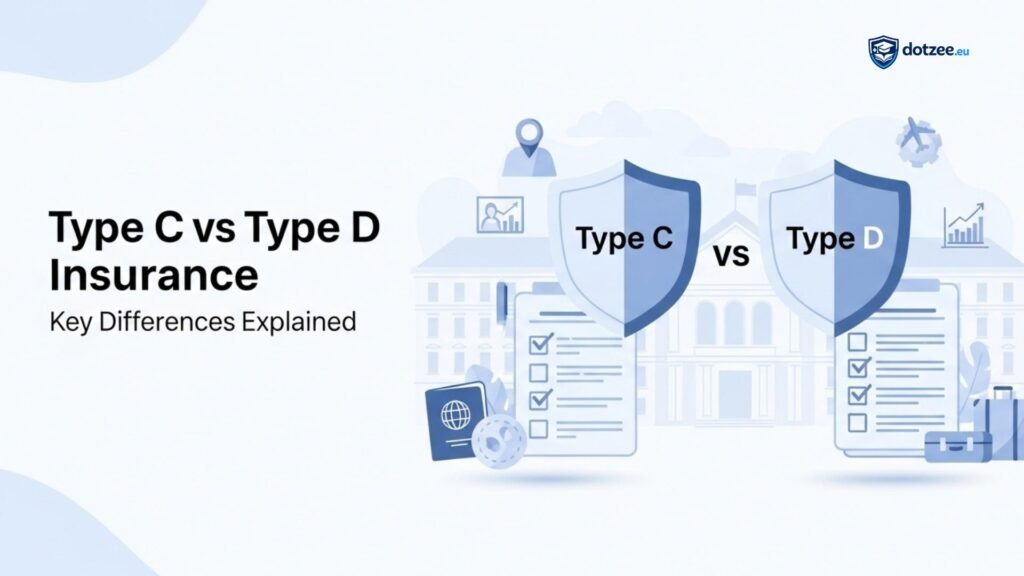
- Duration difference
- Type C: For exact travel dates, maximum 90 days
- Type D: Usually 3 to 12 months, or more
- Scope of coverage
- Type C: Emergency medical coverage only in Schengen countries
- Type D: Can also cover general medical care, not just emergencies
- Price difference
- Type C: Per day, usually 0.5 to 2 euros per day
- Type D: Monthly or annual, 30 to 150 euros per month
- Renewal conditions
- Type C: Usually not renewed, a new policy has to be taken out
- Type D: Can be renewed frequently, or converted to local insurance
✅ How to choose the right insurance policy
Step 1: Confirm your visa type
- This is the first and most important step. If you are not sure what type of visa you need, check the embassy website or consult an expert.
Step 2: Determine the duration
- How many days do you need the visa for?
- Do you want to start traveling immediately after receiving the visa?
- Do you want to stay in Europe after the visa expires?
Step 3: Check the coverage details
- Don’t just check that there is coverage for 30,000 euros—also check:
- Is there COVID-19 coverage?
- Are pre-existing conditions covered?
- Is there dental emergency coverage?
- What is the process for filing a claim?
Step 4: Check the reputation of the insurance company
- At dotzee.eu, we always recommend not just looking at the cheapest policy—look at the company’s reputation as well. Will the company pay out if you have to make a claim? Read online reviews, find out about their claims processing.
Step 5: Prepare documents for the visa application
- Remember: the embassy requires the original insurance certificate, which clearly states:
- Your name
- Policy number
- Duration of coverage
- Amount of coverage (30,000 euros or more)
- Area where coverage is valid
- Name and contact information of the insurance company
📖 Real-life examples: Mistakes to avoid
Case 1: A Pakistani student’s mistake
Ali applied for a master’s in Germany. He took out a cheap insurance policy online that only covered 30,000 euros. The German embassy rejected his application. The reason? His insurance did not include “repatriation” coverage. Ali had to take out new insurance and make a re-appointment—three weeks were lost.
Case 2: A tourist’s carelessness
Sania booked a tour package to France that included insurance. Her bag was stolen in Paris, containing her passport and credit cards. She discovered that her insurance did not cover theft of luggage—only medical emergencies. She had to get a new passport out of her own pocket and buy new return tickets.
Case 3: A businessman’s wisdom
Omar travels to Europe every year for business meetings. He takes out an annual multi-trip insurance policy from dotzee.eu. Once in Amsterdam, he suddenly developed appendicitis. The insurance company immediately contacted the hospital, paid all the expenses, and even rescheduled his flight. If he hadn’t had good insurance, he would have had to pay more than 15,000 euros himself.
💼 How we can help you at dotzee.eu
At dotzee.eu, our mission is to save you from confusion. We have reviewed hundreds of visa applications and know which policies work and which don’t.
We can help you:
- Choosing the right insurance for your visa type
- Understanding the policy details—what’s in the small print
- How to file a claim
- Advice on changing insurance if you’re already in Europe
On our website you’ll find a comparison of different insurance policies, and you can contact us directly if you have any doubts.
Remember: Good insurance is not the cheapest—it’s the one that comes in handy when needed.
❓ Frequently Asked Questions (FAQ)
1: Can I use the same insurance policy for both Type C and Type D visas?
No, usually not. Type C insurance is only for short stays and does not usually have the coverage required for long-term visas. For a Type D visa, you need long-term insurance or local health insurance.
2: What is the minimum coverage for Type C visa insurance?
A minimum of 30,000 euros is required for Schengen countries. This coverage covers medical emergencies, hospitalization, and repatriation costs.
3: Is it necessary to purchase insurance in advance for a Type D visa?
Yes. When applying for a visa, you must provide proof that you have insurance that will be valid for the entire duration of your stay. In some countries, you can take out local insurance upon arrival, but insurance in advance is required for a visa.
4: Is my free credit card insurance sufficient for a visa?
Usually not. Most credit card insurance does not include all the coverage required for a Schengen visa, especially the minimum limit of 30,000 euros and repatriation coverage. It is better to take out visa insurance separately.
5: What if I am already in Europe and want to extend my visa?
You will need to take out new insurance that covers the extension period. Many insurance companies offer policy extensions. At dotzee.eu, we show you policies that can be easily extended.
6: Is there any special insurance for students?
Yes. Most European countries have special insurance packages for students that are cheaper than regular insurance. For example, in Germany, “student health insurance” can be purchased for less than 100 euros per month.
7: Do I need to have my insurance policy translated?
Most embassies accept policies in English. If the policy is in another language, a certified translation may be required. It is best to get a policy in English.
8: Can I get insurance if I have a pre-existing condition?
Yes, but you have to tell the insurance company in advance. Some companies cover pre-existing conditions, some don’t. The premium can usually be higher.
9: Can I buy insurance online?
Yes, most insurance can be bought online. On dotzee.eu, you can compare different policies and get insurance instantly.
10: Can I get a refund if my visa is rejected?
This depends on the insurance company’s policy. Some companies will refund your money if your visa is rejected, but nothing else. Be sure to read this clause before purchasing a policy.
🎯 Conclusion
The difference between Type C and Type D visa insurance is not just about paperwork—it’s about your safety and peace of mind. The right insurance means you can enjoy your trip or stay worry-free.
At dotzee.eu, we understand that the world of insurance can be complicated. That’s why we’ve made our website simple and straightforward—so you can avoid confusion and make the right decision.
Remember: cheap insurance is often expensive. Get good insurance for a little more money, so you won’t regret it when times get tough.
If you have any questions or need advice, contact us at dotzee.eu. We’re here to help.
Safe travels, safe stays!