
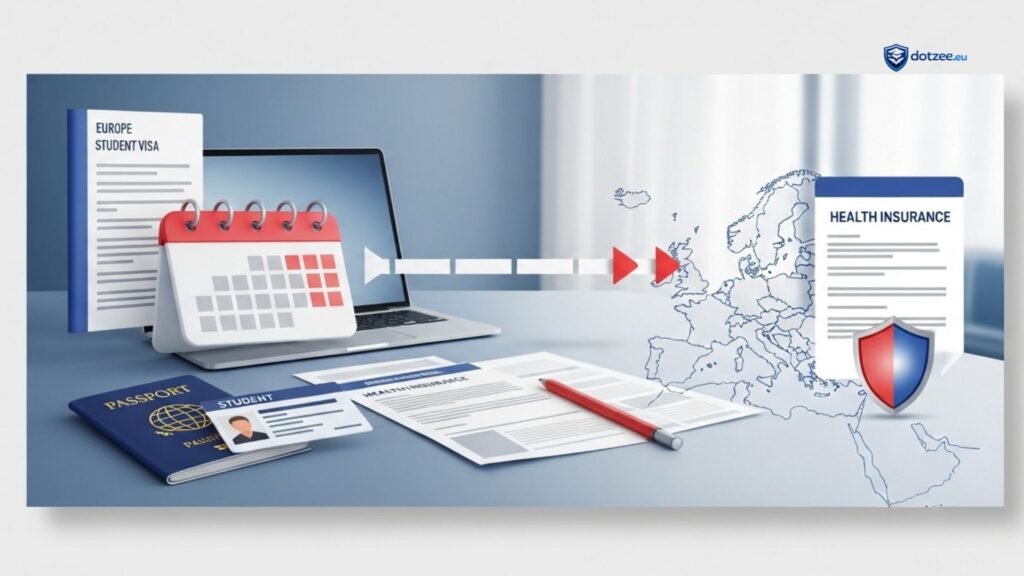

Friends, welcome to my website dotzee.eu 🌍 .Today I have brought a very important topic that causes confusion for every student from Pakistan who wants to study in Europe: the validity period of Europe student visa insurance 🤔
Insurance is mandatory if you want to go to Europe. We all know this ✅ But the real confusion is: how many days should this insurance be taken? Is it from the date of visa issuance to the end of the course? 🤷♂️ Or just for the days of travel? Does it change after reaching Europe? If you make a small mistake, you risk getting your visa rejected ❌
As an insurance advisor from Pakistan and the founder of dotzee.eu, I have seen hundreds of students get out of this dilemma. Today, I will tell you a practical way to solve this problem in the light of my experience, so that you can submit your application with confidence 💪
After reading this article, you will know which countries require insurance for how many days, what the “duration” actually means, and most importantly, what are the common mistakes that lead to Pakistani student visa rejections 📋
So get ready, let’s dive in 🏊♂️
Which visa are you getting? (Type C vs Type D) 🛂
European visas are of two types, and the duration of the insurance depends on this basic difference:
Schengen Short-stay visa (Type C – Short Stay): If you are going to do a course of less than 90 days, for example, a certificate course or summer school, then you will get this visa. For this, insurance is required for the number of days you will stay there 📅
National Long-stay student visa (Type D – Long Stay): If you are going for a bachelor’s, master’s or any other degree program that is more than 90 days, then this visa is for you. And this is where the real story begins 📖
The real problem is with Type D visa holders. The insurance period is not limited to the date of visa issuance.
Insurance Period: Three Important Stages 📊
From entering Europe to completing your degree, the need for insurance changes in three different stages. Let’s understand them in detail:
Stage 1: Visa Application Stage 📝
When you are applying at the German, Dutch or French embassy while sitting in Pakistan, the first goal of insurance is to “get you there” 🎯
At this point, you need travel medical insurance that complies with Schengen rules:
- Minimum coverage: €30,000 (thirty thousand euros) 💶
- Coverage scope: All Schengen countries included 🗺️
- Validity: This insurance should be valid for the entire duration of your trip
But here’s an important point: the validity of this insurance does not start from the date of visa issuance, but from the first days of your arrival in Europe and your stay there ✈️
Example: Let’s say your course starts on October 1, 2026 and you apply for a visa on September 25. The embassy will ask you for insurance that is valid for at least 3-6 months from October 1. Why? Because they want you to have insurance after you arrive in Europe, until you get there and join a “student insurance” or local health insurance 🏥
It’s just like moving to a new city. You stay in a hotel for the first few days, then you find your own place. This initial insurance is your “hotel” 🏨
Stage 2: Immediately after arrival in Europe (Arrival and Registration) 🚪
Upon arrival in Europe, especially in countries such as the Netherlands, Germany, Italy, Spain, you have to register with the local municipality and apply for a residence permit 📋
After this registration, your insurance obligations change. You no longer need “travel insurance”, but “local health insurance” 🔄
- In the Netherlands: If you work part-time (even for one hour), you are required to take out Dutch Basic Healthcare Insurance. Failure to do so may result in a fine 💶
- In Italy: You have to register with the SSN (Servizio Sanitario Nazionale) within 8 days of your arrival in Italy at the local health authority (ASL). The fee is only €149.77 per year, and it gives you the same benefits as local citizens 👍
- In Spain: For a long-term visa, you need to take out private insurance that is registered in Spain and has no “co-payment” or “waiting period”. This insurance should cover you from the start 🇪🇸
Remember: your initial “visa insurance” is only valid until you are enrolled in these local systems ⚠️
Stage 3: Full Duration of Studies 🎓
This is the most important step ⭐
Your insurance (whether it is initial travel insurance or subsequent local insurance) must be valid for the entire duration of your stay 📆
Some countries, such as Finland, have very strict rules. If you are studying for less than 2 years, the minimum medical coverage in the insurance must be €120,000. And this insurance must be for the entire duration 🇫🇮
Common mistake: Students only buy insurance for one month for the visa, thinking that they will arrange the rest when they arrive in Europe. This mistake can lead to the cancellation of your visa. The embassy wants you to have a solid insurance arrangement for at least the first 3-6 months ❌
5 Practical Tips for Pakistani Students 💡

Based on my experience, I am giving you some tips that are not found in general guides:
1️⃣ Take insurance for 1 month more than the length of your course
If your course is 12 months, take insurance for 13 months. This way, you will not be left unprotected during visa processing delays or delays in registration upon arrival in Europe ✅
2️⃣ Check the “Visa Refund” policy
Before buying insurance in Pakistan, be sure to ask whether you get a refund if your visa is rejected. Good companies offer this facility 💰
3️⃣ Check the legality of the company
Especially for countries like Spain and the Netherlands, make sure that the insurance company you are taking a policy from is registered in that country. Policies from local companies are more accepted 🏢
4️⃣ Details on the certificate
Your name on the insurance certificate should be exactly as it appears on your passport. It should clearly state “Schengen Area”, and show coverage of €30,000 📄
5️⃣ Planning to work? So be prepared
If you know you want to work part-time while studying in Europe, do your research beforehand. As soon as you start working, your type of insurance will change (especially in the Netherlands) 💼
Insurance validity in different European countries (Country-wise Overview) 🗺️
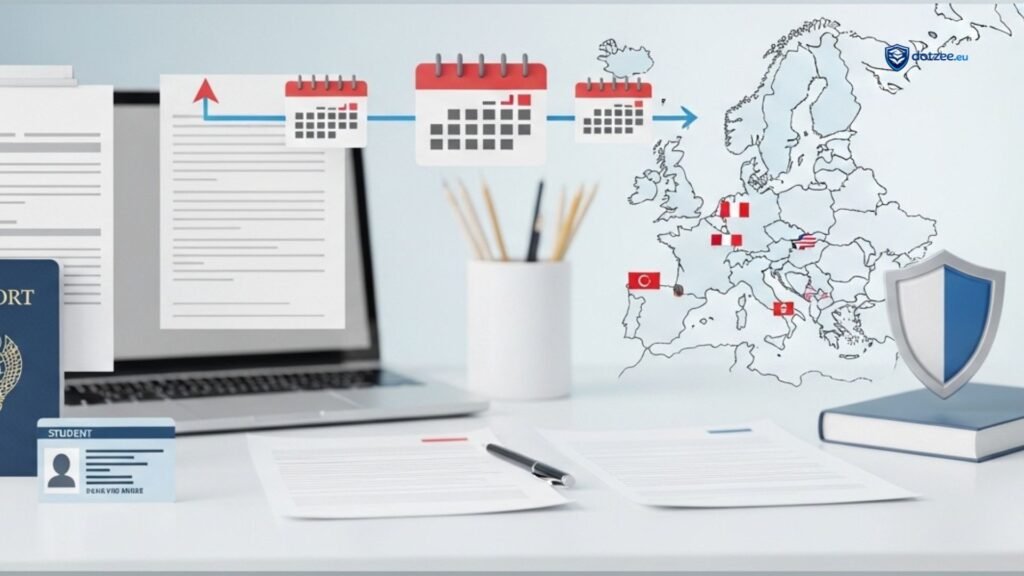
Here are some important countries to give you an idea:
Netherlands
- For visa: At least 3-6 months Schengen travel insurance (€30,000 coverage)
- Local requirement: It is common to take out insurance from a company like AON upon arrival. If you work, Dutch Basic Insurance is mandatory
Spain
- For visa: Travel insurance is not accepted for long-term visas. Private insurance registered in Spain is mandatory with no waiting period
- Duration: For the entire study period
Italy
- For visa: Schengen insurance with €30,000 coverage
- Local requirement: Registration with the SSN (National Health Service) upon arrival. Very cheap and effective 👍
Finland
- For visa: €120,000 coverage is mandatory if the course is less than 2 years. If more than 2 years, €30,000 is enough
- Duration: For the entire duration. No “deductible” should exceed €300
Conclusion 🎯
Friends, at dotzee.eu we always say that insurance is not just a piece of paper, but a means of protecting your dreams 💫 The duration of insurance for a Europe student visa means: you are protected every moment, from the moment you receive your visa until you complete your degree 🛡️
Don’t take the duration of insurance lightly when applying. Check your course dates, check the embassy website (because the rules keep changing), and consult an expert if you are confused 👨💼
Remember, only a well-planned student can successfully travel to Europe 🌟
If you need help choosing the best insurance plan for your case, contact our experts at dotzee.eu. We will give you the best advice based on European requirements, based in Pakistan 🤝
Let me know in the comments section below which country you are going to study in, and I will tell you what the specific insurance requirements are there 💬
Frequently Asked Questions (FAQs) ❓
Can I travel to Europe with only one month of insurance from Pakistan?
This can be risky. The embassy will want you to have at least 3-6 months of insurance, until you get there and join the local system ⚠️
Do I get my insurance money back if my visa is rejected?
Yes, but the condition is that you have taken the insurance that has a “Visa Refund” policy. Be sure to check this before purchasing 💰
Can I change my insurance company after arriving in Europe?
Absolutely! In fact, most students transfer to a local student insurance company (such as AON in the Netherlands) upon arriving in Europe, which is cheaper and more comprehensive 🔄
Will my Pakistani insurance company’s certificate be accepted in Europe?
It will be accepted provided it meets the Schengen rules: €30,000 coverage, valid throughout the Schengen area, and includes ambulance and repatriation ✅
Do I need to carry the original insurance documents with me?
Yes! You must have a printed copy of the insurance certificate at the time of the interview at the embassy and at the immigration checkpoint upon arrival in Europe 📄
Is the European Health Insurance Card (EHIC) valid for Pakistani students?
The EHIC is only for EU citizens. Pakistani students are required to take out separate private insurance ❌
For more information, you can read about the Schengen visa insurance rules on the official website of the European Commission: 🌐



Pingback: Will your EHIC health insurance card support you in Europe? - dotzee.eu
If the situation becomes so serious that you have to be sent back to Pakistan or your home country, EHIC will not pay a single rupee.
Repatriation costs can run into lakhs, sometimes even crores, so it is very important to have full insurance cover in advance