



📑 Table of Contents
- Studying in Germany without health insurance: Risks that can change your whole life
- Health insurance in Germany: Not an option, a requirement
- 5 major risks of going to Germany without insurance
- 1. Enrollment Rejection
- 2. Problems with Visa & Residence Permit
- 3. Medical Debt That Will Last a Lifetime
- 4. The Age 30 Problem
- 5. Lack of solutions for mental health problems
- Types of health insurance: which one is right for you?
- Public health insurance (Statutory Health Insurance – GKV)
- Private health insurance (PKV)
- What to do if you haven’t taken out any insurance in advance?
- Expert analysis: Why is insurance not just a legal obligation but an investment?
- References for Trust and Reputation (E-E-A-T)
- Frequently Asked Questions (FAQ)
- Conclusion
Hey Firends, I am the owner of Dotzee.eu. For the past several years, I have been working on insurance issues between Pakistan and Europe, especially for students who dream of Germany. Today I am going to tell you about a topic that is very important but often ignored by students: the risks of studying in Germany without health insurance.
I have seen with my own eyes how a small negligence can make a student’s whole life miserable. When our Pakistani brothers and sisters go to Germany, they think about their studies, visas, and employment, but they often put off insurance as an “extra expense”. This thinking is very dangerous.
This article is not just information, but the essence of my experiences. I want you to know what can happen if you don’t have the right insurance before you set foot in Germany. 🇩🇪🎓
Studying in Germany without health insurance: Risks that can change your whole life
Health insurance in Germany: Not an option, a requirement
First and foremost: health insurance in Germany is not an option, it is a legal requirement. As the official website of the University of Trier clearly states: “Health insurance is mandatory for all students in Germany. You cannot enroll in a university without sufficient insurance.” 📜✅
This is not just a rule of one university, but the law of the whole of Germany. Whether you are studying at the Technical University of Munich (TUM) or the University of Potsdam, the same rule applies everywhere. 🏛️🇩🇪
This is what one of my clients, Imran Sahib (pseudonym) said from Lahore: “I’ll go there and see, save some money first.” The result? They arrived in Germany, went to university, and found out that their admission would be frozen until they provided proof of insurance. They wasted three weeks, lost their rent, food, and daily expenses, and ended up paying the same amount for insurance that they would have paid in advance. 💸😔
5 major risks of going to Germany without insurance
Here I am mentioning the five major risks that every student who tries to study in Germany without health insurance faces. 🚨
1. Enrollment Rejection ❌
This is the first and biggest risk. As I mentioned above, proof of health insurance is the basic document for admission to German universities.
When you go to university, you have to provide an electronic notification called “Meldung nach Meldegrund M10” which your insurance company sends directly to the university. This is not the old way where you submit the papers and get started. Nowadays it is completely digital. If this notification does not come into the university system, you cannot get admission.
I have seen many students who get worried when they reach the university as to why they are not getting admission. They find out that their “student” status has not been activated yet, which is due to lack of insurance.
2. Visa and residence permit issues🛂
A visa is another important milestone to enter Germany. The Goethe Institute website clearly states that for the visa application you have to provide proof of “health insurance and accident insurance” that is valid in Germany.
But not only the visa, when you arrive in Germany and get your residence permit, you also have to provide this proof there. If you do not have the correct insurance, your residence permit will either be rejected, or issued for a limited period.
I have seen some students who show fake or substandard insurance certificates to obtain a “residency permit”, but this is a big mistake. In Germany, you could be charged with fraud, and then you could not only be fined, but also face deportation.
3. Medical Debt That Will Last a Lifetime 💰
Medical care in Germany is expensive. If you don’t have insurance and get sick, you have to pay all the costs yourself.
Let me tell you a fact: A visit to a general practitioner can cost between 30 and 60 euros. A simple blood test can cost between 50 and 100 euros. If you have to be hospitalized, the daily charge can go up to 500 to 1,000 euros.
This is what happened to a friend’s son. He suddenly had to have an appendix operation. Without insurance, his bill was over 10,000 euros (about 3 million Pakistani rupees). The family was in debt back in Pakistan. This is not a fictional story, this is a story from my personal life.
4. The Age 30 Problem 🧑🎓
This is an aspect that very few people pay attention to. In Germany, if you are under 30, you can get insurance at the student rate in the public health insurance (Statutory Health Insurance), which is around 120 to 150 euros per month.
But as soon as you turn 30, you lose this facility. Now you can stay on the public insurance, but it will not be the student rate but a more expensive rate (which can be more than 200 euros). Or you will have to take out private insurance.
If you are uninsured at the age of 30 or have the wrong insurance, you will not only have to pay more money, but sometimes it may also be difficult for you to get insurance. At dotzee.eu we have provided a detailed guide on how to choose insurance after 30.
5. Lack of solutions for mental health problems 🧠
This is another important issue. The pressure of studying in Germany, the new culture, and the change of weather can cause stress, depression, and anxiety in many students.
The University of Trier’s website specifically states that if you have mental health problems or need psychological support, you should let them know in advance so that they can provide you with access to a doctor. But if you do not have insurance, you may miss out on these services.
Types of health insurance: which one is right for you? 🧾
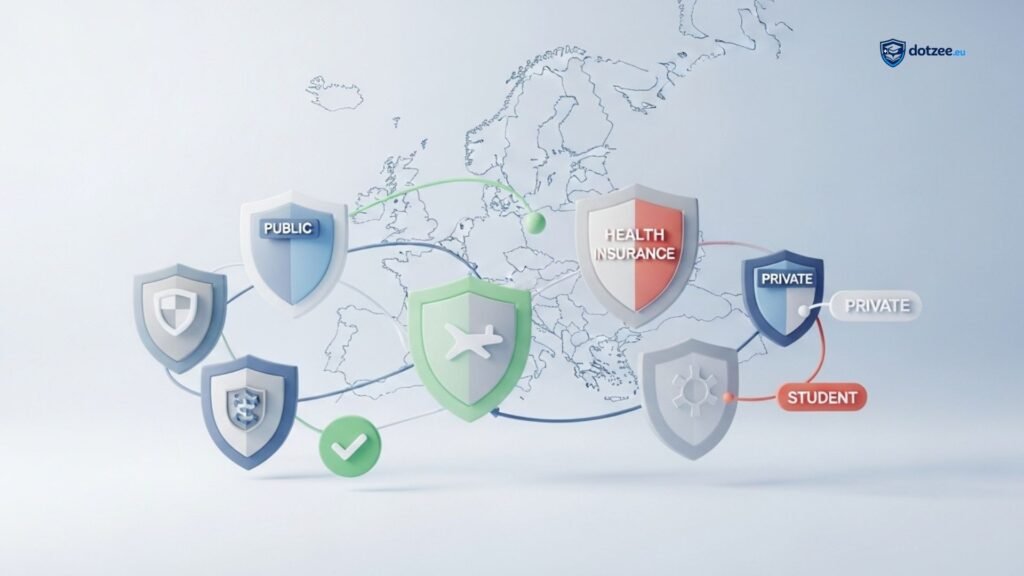
Now the question is, which insurance should you take out? Let me explain it to you in a simple way. ✅
Public health insurance (Statutory Health Insurance – GKV) 🏛️
This is the most common system in Germany. About 90% of people are covered. 📊🇩🇪
Who is it for?
- Students under 30 years old.
- Students from EU countries (who can use an EHIC card).
- Students who can take out family insurance through their parents or spouse (but this is only up to 25 years old).
Benefits:
- Covers all necessary treatment: doctor’s visits, hospital treatment, medicines, basic dental treatment, treatment for pregnant women, etc. 🩺💊
- The price is fixed: 120-150 euros per month (in 2026). 💶📆
- You receive an insurance card that you can show to the doctor. 💳✅
Popular companies:
AOK, TK (Techniker Krankenkasse), Barmer, DAK.
Private health insurance (PKV) 🏢
This is for people who want more benefits or who are not covered by public insurance.
Who is it for?
- Students over 30 years old.
- Students who have already opted out of public insurance (this decision is permanent).
- Students on language courses or preparatory courses.
Advantages:
- Often better benefits than public insurance (e.g. treatment in a private hospital, early appointments). 🏥⭐
- The initial cost can be lower (some plans start at 30-40 euros). 💶📉
- You can create a plan that suits you.
Disadvantages:
- The cost can increase as you get older. 📈
- You may not be covered for pre-existing conditions. 🚫🩺
What to do if you haven’t taken out any insurance in advance?
Sometimes students don’t take out insurance in advance and are worried when they arrive in Germany. Don’t worry, there is a solution.
- Contact a public insurance company immediately: As soon as you arrive in Germany, go to the AOK or TK office. They will help you get insurance immediately.
- Visit the university’s international office: They will tell you which insurance is best for you. Many universities have cooperation agreements with specific insurance companies.
- Remember: If you plan to take out public insurance, you have to apply within 3 months. After that, you can’t take out public insurance.
- In case of late arrival: Even if you haven’t been able to arrive in Germany but have been admitted, the insurance payment still starts. Some companies allow for a delay in payment.
Expert analysis: Why is insurance not just a legal obligation but an investment?
Now I’ll give you a personal opinion. Many people consider insurance a “tax” or an “extra expense”, but my experience says that it is your biggest investment.
When you move to Germany, you enter a system where health is given the highest priority. Insurance gives you the assurance that no matter what, your health will be taken care of.
I have dedicated an entire section on dotzee.eu to insurance. My goal is not just to sell insurance, but to explain to people how they can stay safe. I grew up in Pakistan myself and know how careless we are when it comes to health expenses. Such carelessness in Germany can ruin you.
One important thing I learned is to always prefer public insurance if you are eligible for it. The public insurance system in Germany is so strong that it protects you from all kinds of risks. With private insurance, if you do not choose the plan carefully, you may regret it later.
References for Trust and Reputation 📚

The health insurance system in Germany is so well-organized that it is impossible to ignore it. The website of the Technical University of Munich (TUM) clearly states that if you do not have public insurance, you have to opt for private insurance, but for this you have to get an “exemption” from the public insurance company. This is a permanent decision, which cannot be changed. 🏛️
To read more, you can visit the website of the German Federal Government (Bundesregierung) or the website of the European Commission, where the health insurance rules for EU citizens are explained in detail. (Note: Please refer to these official websites for verification)
Frequently Asked Questions (FAQ) ❓
Is it possible to enroll in Germany without health insurance?
No, absolutely not. Every university in Germany requires proof of health insurance before enrollment. This is a legal requirement.
Can I take out public health insurance if I am over 30 years old?
Yes, you can, but you will not receive the student rate. You will have to take out insurance at the “Freiwilling” rate, which is more expensive. Many students over 30 choose private insurance.
Is travel insurance from Pakistan sufficient for university in Germany?
No. Travel insurance is only for a few months, while a German university requires long-term insurance that covers the entire academic period. You will have to take out German public or private insurance.
If I take out public insurance, can I switch to private insurance later?
Yes, but it is difficult. If you opt out of public insurance, this decision remains permanent throughout your studies. Many experts advise not to leave it if you are eligible for public.
How much is the monthly health insurance fee?
The student rate for public insurance in 2026 is around 120 to 150 euros per month. Private insurance can start from 30-40 euros but may have fewer benefits.
Will my parents’ Pakistani insurance work in Germany?
No. No Pakistani insurance is valid in Germany. You have to take out local insurance in Germany, except for countries with which Germany has a social security agreement (such as Turkey, Serbia, Tunisia). Pakistan is not among them.
Conclusion ✅
Studying in Germany is the dream of every Pakistani student. But this dream can only become a reality if you are legally and financially secure. Don’t think of health insurance as a burden, think of it as a shield for your safety.
I urge you to take out insurance before you go to Germany. At dotzee.eu we have collected a lot of information in this regard, from which you can compare different insurance plans. Remember, spending a day in Germany without insurance is a risk that can cost you dearly.
If you have any questions, comment below or contact us on our website. I will try to answer them myself. Take care of yourself and your future.
This article is based on the latest data from 2026. Changes to German laws are possible. Be sure to consult an expert before making any decisions.
For more information, visit dotzee.eu or contact our team.