

📑 Table of Contents
- The Ultimate Checklist for Health Insurance for Students in Europe (2026)
- Step 1 – Know your status: What type of student are you?
- 1. European Union (EU) or EEA citizens
- 2. Non-EU/EEA students (that’s us – Pakistanis)
- 3. Exchange students (Erasmus+ etc.)
- Country-by-country guide: What is the principle of health insurance in Europe?
- Germany – the rules are a bit stricter here
- Netherlands – A slightly different system
- France – Mixed system of fees and coverage
- Sweden – Focus on emergencies
- Austria – Public insurance system
- Visa Insurance: The First and Most Important Requirement
- University Admission: The Second Insurance Exam
- Electronic message system (Germany/Austria)
- For those with a European Health Insurance Card (EHIC)
- Which plan is best? Public vs. Private
- Public Health Insurance
- Private / International Student Insurance
- The 3 biggest mistakes Pakistani students make
- How to make a claim? (Step-by-Step)
- Additional insurance: Is health enough?
- Authority Signals
- Conclusion
- Frequently Asked Questions (FAQs)
- Step 1 – Know your status: What type of student are you?
Hey Firends!I have been providing insurance guidance to Pakistani students and professionals living in Europe. Today, I have brought you a comprehensive checklist that will not only get you out of the complicated web of health insurance while studying in Europe, but will also protect both your pocket and your nerves.
Going to Europe is the dream of every Pakistani student, but often, as soon as the visa is applied, we ignore the word “insurance” or are happy to buy the cheapest plan. I have seen firsthand how a small illness can make the life of a student miserable by creating a bill of millions of rupees.
The Ultimate Checklist for Health Insurance for Students in Europe (2026) 📋
Studying in Europe is a huge step in itself. Be it a technical university in Germany, an art school in France or a business school in the Netherlands, each country has its own unique system. But one thing that is common to all is health insurance. It is not an option but a basic requirement for visa and university admission.
Here I will tell you how you will not only meet the legal requirements but also be able to best protect both your health and your wallet. 🩺
Step 1: Know your status: What type of student are you? 🧑🎓
The most important question before buying insurance is which category you legally fall into. Buying insurance in the wrong category can cost you dearly later or even lead to a claim being rejected.
1. European Union (EU) or EEA citizens
If you have an EU passport, you are in luck. You can get a European Health Insurance Card (EHIC) from your home country. This card gives you the same medical coverage as a local citizen in any EU country.
Most Pakistani students: We do not fall into this category. We are called “Third Country Nationals”.
2. Non-EU/EEA students
We are the ones who need a visa. Insurance is part of our visa application and then we have to prove it when we apply for university. There are two options for us:
- Statutory/Public insurance: In some countries (e.g. Germany, Austria, Belgium) you are required to have public insurance until you are 30 years old. This is cheaper and provides better coverage. 🏥
- Private insurance: In some countries (such as the Netherlands, France, or if you are over 30 in Germany) you have to take out private insurance. 🔒
3. Exchange students 🤝
If you are going under Erasmus+ or another exchange program, insurance is often pre-arranged by your host university or program. For example, exchange students in Sweden are covered by Student IN insurance.
Country-by-country guide: What is the principle of health insurance in Europe? 🗺️
Look, Europe does not just mean “Schengen visa”. Each country has its own rules, and if you choose the wrong insurance, there is always the risk of your visa being rejected. I have shared several cases on my website dotzee.eu where students took the wrong insurance in order to save money and lost their entire session. 😢📉
Let’s understand in simple terms what is required in which country:
Germany – the rules are a bit stricter here
In Germany, the issue of insurance has to be taken quite seriously.
- If you are under 30 years old: then you have no choice but to go for the state insurance (Gesetzliche Krankenversicherung – GKV).
What to do? Contact reputable companies such as TK, AOK, or Barmer. According to estimates for 2026, a student could have to pay around 140 euros per month for health and nursing cover combined.
Important note: If you have taken out a cheap private insurance plan from abroad, the university will not allow you to enroll unless you switch to the public insurance. 🚫📝 - Over 30: If you are over 30, the public student rate ends. You will now have to take out private insurance at the market rate, which can be quite expensive. 💶⚠️
Netherlands – A slightly different system
The Netherlands has a slightly different approach. The Dutch Health Insurance Act applies here when you are working or doing a paid internship.
- Key point: If you are only going to study and not working, you can take out private international student insurance (such as AON or IPS), which is sufficient.
- Remember: if your stay exceeds 180 days, international health insurance is mandatory. 📅✅
France – Mixed system of fees and coverage
The rules for students in France have changed a little.
- CVEC fee: First of all, you have to pay about 100 euros per year called ‘CVEC’ (Contribution Vie Etudiante et de Campus) . This provides you with basic medical care. 🏛️
- Better coverage: CVEC alone is not enough. For better treatment, you should take out ‘CMU’ (public cover) or private ‘Mutuelle’ (top-up insurance) to reduce the burden of medicines and doctor’s fees. 💊
Sweden – Focus on emergencies
For students from third countries (such as Pakistan) going to Sweden, FAS+ insurance is usually mentioned.
- Coverage: This policy provides 24-hour coverage, including emergency medical, dental, and, God forbid, the cost of repatriating the body in the event of a tragedy. 🕊️
- Caution: This insurance is mostly for “emergency” situations. Routine check-ups or treatment of pre-existing conditions are not covered, so it is best to take out additional cover if your budget allows. ⚠️
Austria – Public insurance system
The state-run health insurance company in Austria is the ÖGK.
- Cost: The cost for students in 2026 is around €78.84 per month. 💶
- Fact: Having an insurance card here does not mean that doctors will automatically come to you. In the Austrian system, you have to find your own doctor (General Practitioner) who accepts your insurance, even if you have insurance. 🧑⚕️
Visa Insurance: The First and Most Important Requirement 🛂
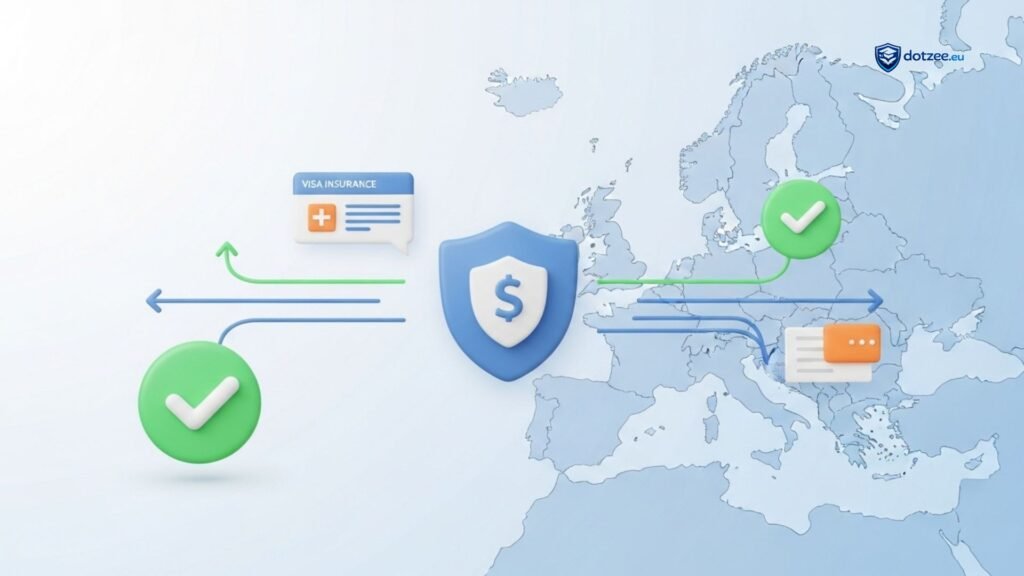
You have to take out travel insurance for a Schengen visa (which is granted for the first 3-6 months). But keep in mind, this travel insurance is not enough to get into a university after arriving in Europe. 🎓
What to look for in travel insurance:
- At least 30,000 euros coverage: This is the basic requirement for a Schengen visa. 🛡️
- Repatriation: If a tragedy occurs, there must be coverage to send the body home.
- Valid for the entire Schengen area: not just for one country. 🌍
Warning: Many Pakistani students buy “cheap insurance” after watching on YouTube. My personal opinion is to get insurance from a reputable company for the visa. I have seen that the embassy sometimes objects to insurance from small companies. 🚫
University Admission: The Second Insurance Exam 📑
Once you reach Europe with a visa, the first thing to do is register at the university. Here your insurance is checked again. 🔍
Electronic message system
To enroll in Germany, you need to send an electronic report (M10 Meldebescheinigung) from a public insurance company (e.g. TK, AOK) to the university. If you bring a printout of your private insurance, they will not accept it.
For those with a European Health Insurance Card (EHIC) 🪪
If you are an EU citizen or have an EHIC, you need to take it to a German or Austrian insurance company so that they can validate it and send it to the university. ✅
Which plan is best? Public vs. Private ⚖️
This is the question that every student asks. Let’s understand the difference.
Public Health Insurance 🏥
Where is it available? Germany, Austria, Belgium, France (partial)
Pros:
- Low premium: The cheapest option for students. 💶
- Cashless: You don’t have to pay upfront, just show your card. 💳
- Comprehensive: Dentist (basic), hospital, medicines are all covered. 🦷
Cons:
- Only valid in the country where you are studying. Only emergency cover if you go to another European country. 🌍
Private / International Student Insurance 🔒
Where available? For those aged 30+ in the Netherlands, Sweden, or Germany.
Pros:
- Europe-wide cover: Most international plans are valid throughout Europe. 🌍
- Flexibility: You can choose your own doctor (somewhere). 🧑⚕️
Cons:
- First-pay system: You have to pay the bill yourself first, then file a claim for reimbursement.
- Coverage differences: Some cheaper plans don’t cover pre-existing conditions. ⚠️
My opinion: If you’re under 30 and going to Germany or Austria, government insurance is best. If you’re going to the Netherlands or Scandinavia, get a private plan from a good international company. 🧠
The 3 biggest mistakes Pakistani students make
I have heard many student stories on dotzee.eu.Some common mistakes to avoid.
- Buying only 6 months of insurance: Many students buy 6 months of insurance for their visa, thinking that they will get a new one when they reach Europe. The problem comes when the visa is granted for more than 6 months or when you need a doctor after a year and a half, you find out that the insurance has expired. Strategy: Arrange insurance for the entire duration of your studies in advance. 🗓️
- Hiding old diseases: If you have diabetes, thyroid, or any other old disease, it is mandatory to tell the insurance company. If you hide it and get it treated later, the company may reject the claim and you may even be sued for fraud. 🏥
- Not getting pre-authorization before going to the doctor: Private insurance often requires that you notify the insurance company before you are admitted to the hospital. If you go without informing even in an emergency, the company will not reimburse you in full in up to 63% of cases. 📞
How to make a claim? (Step-by-Step) 📄
The claim process is very important here.
- Save the receipt: Whether it is a doctor’s bill, a medicine bill, or an ambulance charge, save every document. 🧾
- Fill out the form: Download the claim form from your insurance company’s website.
- University verification: In countries like Sweden, it is necessary to have the university’s international office verify that you are indeed a student on the claim form.
- Submit: Mail or email all documents (form + receipt) to the company. 📮
- Timeline: Most companies refund your money within 30 days of filing a claim. In some countries (like Sweden), you have 3 years, but the sooner the better. ⏱️
Additional insurance: Is health enough? 🛡️
Liability insurance is a big deal in Europe.
Why? Suppose you spill water on your neighbor’s expensive laptop in your dorm, or accidentally scratch someone’s car while riding your bike. Liability insurance covers this expense. 🚲
Many health insurance plans don’t cover this. In Germany, it’s called Privathaftpflichtversicherung, and it costs just 50-70 euros per year. It’s a small expense that can save you from a huge disaster. 👍
Authority Signals 🔗
Whenever you buy insurance, don’t just trust the salesperson. The most authoritative are the official websites of the European government and universities.
For example, if you are going to Germany, check the laws on official websites like the Hessian Administration Portal. Similarly, if you want details about the European Health Insurance Card, the official website of Europa.eu is the best.
Conclusion 🎯
Student health insurance in Europe is not a difficult task if you understand the steps.
- First decide on the country.
- Then check your age (under or over 30). 🧑🎓
- Get travel insurance for your visa. 🛂
- Switch to a public or private plan after reaching university. 🏫
- Always add Liability Insurance.
Remember, insurance is not an expense but an investment. One day the hospital bill can be more than your semester fees. Don’t put your health and future at risk. 💪🩺💶
Frequently Asked Questions (FAQs)
These are the questions that come to the mind of every student. I have tried to answer them in very simple and practical terms so that you do not get confused.
Can I get insurance for Europe from Pakistan?
Yes, absolutely. In fact, while applying for a visa, you have to buy travel health insurance from Pakistan so that the embassy is sure that you have medical cover.
But… there is a “but” here! ✋
When you reach Europe and go to get admission in a university, most countries (especially Germany) will say that “now you have to get local health insurance here”. So the insurance in Pakistan is only for the visa and initial trip, local insurance is mandatory for longer stays. 🏥✅
Can we Pakistani students get a European Health Insurance Card (EHIC)?
The simple answer is: No. 😔
This card is only for those who are citizens or residents of European Union (EU) or EEA countries. We have Pakistani passports, so we cannot be part of this scheme. You will have to take out your own insurance. 🛂📄
I am over 30 years old, moving to Germany, what should I do now?
See, the German system is a bit “age-listed”. If you are under 30, you get cheap government insurance. But as soon as you cross the 30 mark, that student discount ends.
Now you have two options:
- Voluntary insurance (government): It can be expensive (sometimes above 200 euros). 💶⚠️
- Private insurance: It can be cheap, but be careful!
⚠️ Important advice: Before taking out private insurance, ask your university by email “Will you accept this plan for admission?” Otherwise, you may regret it later. 📧🏫
Is dental treatment covered by insurance?
It’s a bit complicated, read carefully:
- In government insurance: Basic work such as a dental check-up, simple fillings, or treatment in case of pain is usually covered. 🦷✅
- Expensive treatments: Implants, braces, or cosmetic dentistry are usually not covered. ❌💸
- Private/student plans: Most cheap plans only cover dental cover for “emergencies” (for example, if a tooth suddenly breaks or there is severe pain). 🚨🦷
If you have a chronic dental problem, it is wise to get it treated here before traveling to Europe. ✈️🦷👍
This article was written for dotzee.eu. We are committed to providing authentic information about insurance in Germany. If you any questions, contact us.



Pingback: Student Insurance for Medical Students in Hungary: The Complete Guide
For non-European students in Hungary, especially Pakistani medical students, having private health insurance is not just an option but a legal requirement. It is mandatory to have insurance so that any medical issues during your studies can be safely covered.