📑 Table of Contents
- What is a Minijob? New Limits and Conditions from 2026
- Health Insurance for Students in Germany: Basic Requirements
- How Does a Mini‑Job Income Affect Your Student Insurance?
- Case 1: Family Insurance
- Case 2: Compulsory Student Insurance
- Case 3: Private Insurance
- Public vs. Private Health Insurance: Which is Better for Students Working for Money?
- Social Security Contributions: What Do You Have to Pay in a Mini Job?
- Practical Advice: How to Comply with Insurance Rules While Doing a Mini‑Job
- Common Mistakes That Students Make (And How to Avoid Them)
- Expert Insight: Exclusive Advice from dotzee.eu
- Frequently Asked Questions (FAQ)
- One Last Thing
If you are studying in Germany or planning to move there, you must have heard the name “money jobs”. Part‑time work in Germany for international students is not only financially beneficial, but it also gives you a great opportunity to understand the German work culture. But here comes an important question: when you do a money job, how does it affect your health insurance? 🤔
I have seen many students fall into this confusion while living in Germany and working in the insurance sector. Some students think that doing a money job will end their student insurance, while others think that they no longer need to take out any additional insurance. The reality is different.
In this article, I will tell you everything you need to know about German student insurance for money jobs. This guide is based on the latest laws, income limits, social security rules and practical advice from 2026. My goal is to avoid any unnecessary hassle or finality for you.
If you want more reliable information on insurance topics, you can visit dotzee.eu, where we explain complex insurance issues in a simple and practical way. 🌐
What is a minijob? New limits and conditions from 2026 📌
First of all, it is important to understand what a “minijob” actually is in Germany. A minijob is a part‑time job in which your monthly income does not exceed a certain limit. This limit is updated every year with changes to the German minimum wage.
Key figures for 2026:
- 📆 Monthly mini‑job limit: €603
- 📅 Annual limit: €7,236 (€603 × 12 months)
- 💶 Minimum wage: €13.90 per hour
- ⏱️ Estimated maximum hours: approximately 43 hours per month (at minimum wage)
It is very important to understand these figures, as your insurance status is directly linked to your income and hours worked. If you start earning more than €603 per month, your job may fall into the category of a “midi‑job”, which has its own separate rules and insurance requirements.
As a Pakistani student, you should also remember that in a mini‑job you are usually not subject to income tax, but this income is not “tax‑free” in terms of taxation. In practice, if you have no other German income, your tax burden may be negligible.
Health insurance for students in Germany: basic requirements 🏥
Health insurance is legally mandatory for everyone living in Germany, and students are no exception. When you enroll in a public or accredited university, you have to present proof of insurance.
Basic insurance options for students:
- 👨👩👧 Family insurance: If one of your parents has public health insurance (GKV) in Germany, you can be covered by their insurance for free until the age of 25. But your own income must not exceed €535 per month (2025 figures).
- 🎓 Compulsory student insurance: Students under the age of 30 can join public health insurance under a special student tariff. This is cheaper than for ordinary employees.
- 🔒 Private Health Insurance: If you are over 30 years old, or you want to be exempt from public insurance, you can take out private insurance. But once you take out private insurance, you cannot go back to public insurance while you are studying.
- 🔄 Voluntary Insurance: If your compulsory student insurance ends (for example after the age of 30), you can join public insurance voluntarily, but the cost is usually higher.
An important point here is that taking a job does not automatically end your student insurance, provided that you work less than 20 hours a week and your studies remain your main priority.
How does a mini‑job income affect your student insurance? 💶⚖️
Now let’s get to the real question: when you do a mini‑job, how does it affect your health insurance?
The answer depends on your income, the hours you work and the type of insurance you currently have.
Case 1: You are covered by family insurance 👨👩👧
If you are covered free of charge by your parents’ or spouse’s public insurance, doing a mini‑job will only affect your insurance if your monthly income exceeds €535 (the 2025 limit).
In 2026, this limit has increased to €603, but there may be different limits for family insurance, so be sure to check with your insurance provider.
Case 2: You are covered by compulsory student insurance 🎓
If you are covered by public health insurance as a student, taking on a mini‑job does not have a negative impact on your insurance, provided that:
- ✅ You work less than 20 hours a week
- ✅ Your studies remain your main activity
- ✅ Your monthly income does not exceed €603
If you start working more than 20 hours a week, your status as a “working student” may change, and you may have to pay full social security contributions as an employee.
Case 3: You are covered by private insurance 🔒
If you have private health insurance, taking on a mini‑job does not have a direct impact on your insurance. However, if your income increases above €603, you should inform your insurance provider, as your insurance conditions may change.
💡 Practical advice: Always inform your insurance provider before starting a mini‑job. This small precaution can save you from big problems in the future.
Public vs. Private Health Insurance: Which is Better for Students Working for Money? ⚖️
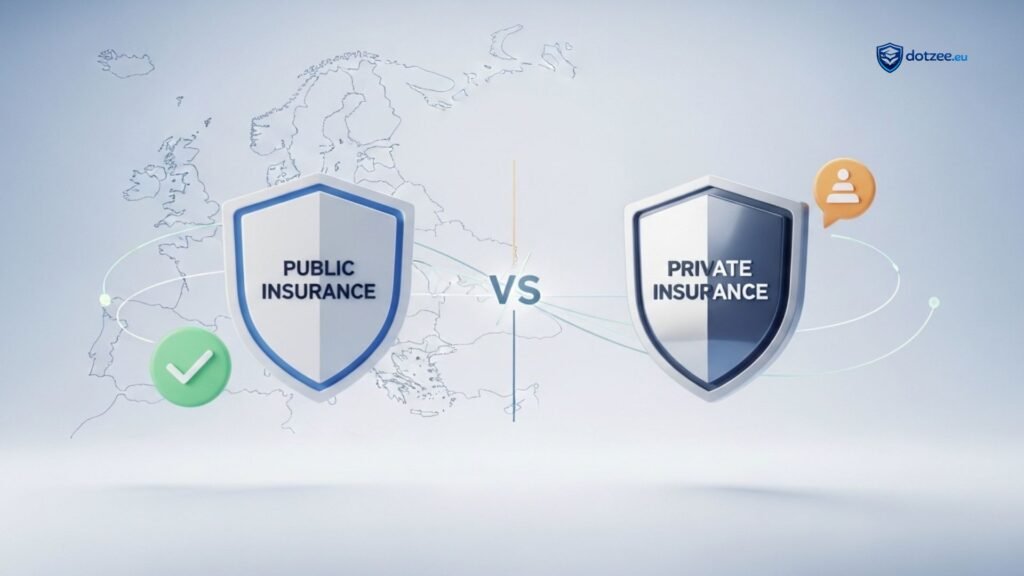
This question comes to every student’s mind. Both have their own advantages and disadvantages.
Advantages of public health insurance (GKV) ✅
- 💰 Fixed cost: The monthly premium for students is around €120–€130, independent of income
- 👨👩👧 Family coverage: If you are married or have children, they can join for free
- 🩺 Coverage of pre‑existing conditions: Public insurance covers pre‑existing medical conditions
- 🔄 Flexibility: If your income decreases, your premium does not increase
Advantages of private health insurance (PKV) ⚡
- ⏱️ Fast service: You can get an appointment with a doctor quickly
- 🏨 Better facilities: Private rooms, better medicines, etc.
- 💶 Cheaper at a young age: Private insurance can be cheaper for young and healthy students
In the context of a mini‑job: If you are doing a mini‑job and your income is unstable, public insurance is a safer choice. In private insurance, if your income increases, your premium may also increase.
In my personal opinion, public health insurance is better for most international students, especially when they are relying on an irregular source of income such as a mini job.
Social security contributions: What do you have to pay in a mini job? 📑
The main feature of a mini job is that social security contributions are much lower than in a regular job or sometimes not at all.
Social security rules in a mini job (2026):
- 🏦 Pension insurance: In general, employees in a mini job have to pay a 3.6% contribution to pension insurance, but you can also opt‑out of this.
- 🏥 Health insurance: You do not get health insurance coverage through a mini job. You have to keep your health insurance separate (student insurance, family insurance, or private).
- 📉 Unemployment insurance: There is no unemployment insurance contribution in a mini job.
- 🤝 Care Insurance: This is also not included in the mini‑job.
Important note: If your mini‑job income exceeds €603, you may fall into the “Midijob” category, where you have to pay full social security contributions, but the employee’s share of the contribution is reduced.
As a Pakistani student, you should also remember that it is very important to obtain a social security number (Sozialversicherungsnummer) , even if you are doing a mini‑job. This number is used in all your official dealings.
Practical advice: How to comply with insurance rules while doing a mini‑job? 💡
I have seen many students who get into big trouble because of small mistakes. Here are some practical tips that will keep you safe:
- 📞 Inform your insurance provider first
Before starting a mini‑job, call or email your health insurance provider and let them know how many hours you will work and how much you expect to earn. This little thing can save you a lot of trouble in the future. - 📝 Keep a record of your income
Keep a record of your earnings each month. If your income is approaching €603, reduce your working hours the following month. Remember, the annual limit is €7,236, but it is easier to keep track of the monthly limit. - ⏰ Take the 20‑hour rule seriously
If you work more than 20 hours a week, your student status may be affected. This could result in your student insurance being terminated and you may have to pay full contributions as an employee. - 🏖️ Take advantage of lecture‑free periods
In Germany, students can work more than 20 hours a week during holidays (such as summer or winter holidays), provided that this period does not exceed 26 weeks. This is a great opportunity to increase your income without changing your insurance status. - ⚠️ Be careful with multiple mini‑jobs
If you are doing more than one mini‑job, remember that their combined income should not exceed €603. If your total income goes above this limit, all your jobs may be covered by social security. - 📄 Make sure to get a written contract
Always get a written contract from your employer that clearly states your salary, working hours and other terms. This document is very important to protect your rights.
Common mistakes that students make (and how to avoid them) ❌
I have personally seen what common mistakes students make. By avoiding them, you can save yourself time, money and stress.
Mistake 1: The misconception that “mini‑jobs are tax‑free” 💸
Many students think that mini‑job income is completely tax‑free. The fact is that this income is taxable, but in practice, if you have no other German income, your tax burden may be negligible. It is better to file a tax return at the end of the year so that if you are due to receive a tax refund, you do not miss out on it.
Mistake 2: Not informing your insurance provider
Some students think that a mini job is a small thing, so there is no need to tell your insurance. This misunderstanding can be costly. If your insurance provider later finds out that you were working, they may cancel your policy or charge additional fees.
Mistake 3: Ignoring the annual limit 📅
Many students only pay attention to the monthly limit (€603), but forget about the annual limit (€7,236) . If you earn more some months and less some months, your total income at the end of the year may exceed the limit, which can change your insurance status.
Mistake 4: Jumping into private insurance without thinking 🏃♂️
Some students take out private insurance because it seems cheap at first. But once they are over 30 or their income increases, the cost of private insurance can be very high. Always consider the long‑term impact.
Expert Insight: Exclusive Advice from dotzee.eu 🧠
As an insurance expert, I have helped many international students. Here is some advice I usually give to my clients:
Tip 1: Always keep your insurance documents safe. Make digital copies and upload them to cloud storage. If you lose your passport or residence permit, these documents can be helpful in renewing your insurance.
Tip 2: If your income is unstable (such as seasonal work), it is safer to stay with public health insurance. With private insurance, if your income decreases, your premium does not decrease, while with public insurance your premium remains constant as a student.
Tip 3: The insurance system in Germany may seem complicated, but you are not alone. If you have any questions, contact your university’s student services (Studierendenwerk), or ask our team at dotzee.eu for help. We are experts in explaining insurance matters in simple terms.
Tip 4: In addition to your health insurance, consider legal protection insurance (Rechtsschutzversicherung) and liability insurance (Haftpflichtversicherung) . These insurances are inexpensive but can protect against unexpected legal or financial losses.
For more official and reliable information about health insurance in Germany, you can visit the German government’s health website gesund.bund.de, where all insurance rules for students are explained in detail.
Frequently Asked Questions (FAQ) ❓
What is the current limit for a mini job in Germany?
In 2026, the monthly limit for a mini job is €603, while the annual limit is €7,236.
Will taking on a mini job cause my student health insurance to end?
No, provided that you work less than 20 hours a week and your studies remain your main activity. Your insurance status only changes if your income or working hours exceed certain limits.
Can I stay covered by family insurance while taking on a mini job?
Yes, if your monthly income does not exceed the family insurance threshold (approximately €535–€603), you can be covered for free under your parents’ or spouse’s public insurance.
What happens if I earn more than €603?
If you regularly earn more than €603, your job may fall into the category of a “midi job”, in which you have to pay full social security contributions. There is sometimes room for unexpected overshoots (up to two months a year, up to €1,206 per month).
Do I get health insurance in a mini job?
No, you do not get health insurance coverage through a mini job. You have to have your own health insurance separately (student insurance, family insurance, or private).
Can I have more than one mini‑job?
Yes, but the total income from all your mini‑jobs must not exceed €603 per month. If the total income exceeds this limit, all your jobs may be subject to social security.
Is the income from a mini‑job taxable?
Technically yes, but in practice, if you have no other German income, your tax burden may be negligible. It is best to file a tax return at the end of the year.
What happens if I work more than 20 hours a week?
If you work more than 20 hours a week, your student status may be affected, and you may have to pay full social security contributions as an employee. However, there is scope to exceed this limit during holidays (maximum 26 weeks).
Can I take out private health insurance while doing a mini‑job?
Yes, you can take out private health insurance while doing a mini‑job. But remember, once you take out private insurance, you cannot go back to public insurance while studying.
How do I verify that my insurance is in order?
Contact your insurance provider directly and tell them the details of your mini‑job. They can give you written confirmation that your insurance status is up to date. You can also get a free consultation on dotzee.eu.
One last thing
Working as a student in Germany can be a great experience, provided you understand the rules and act carefully. Never neglect the issue of health insurance, as it is the basis of your health and financial security.
If you found the information in this article useful, or if you have any further questions, visit dotzee.eu. We are always ready to explain complex insurance issues in your language, in a simple and practical way. 🌐
Remember, the right information and timely action can save you from big problems. Focus on your studies, take your work seriously, and always keep your insurance up to date.
Wishing you success and good health! 💪
Pingback: Can I change my health insurance during my studies in Germany? Complete Guide - dotzee.eu
Yes, of course! If you want to get an exemption from public insurance, you must apply within the first 3 months. You will not get the exemption if you are late, so it is very important to apply on time.