If you’re going to study in Latvia — whether you’re a degree student, an exchange student, going on Erasmus, or moving to Europe for the first time from Pakistan — there’s one thing that can be really expensive to take lightly: health insurance.
I see one thing time and time again while working in the insurance niche: students focus a lot on admission letter, accommodation, and visa documents, but rush to buy an insurance policy at the last minute. It turns out later that the policy was probably enough for the visa, but not for the residence permit; or the EHIC was there but there was no repatriation cover; or the policy was valid for Latvia but didn’t include Schengen-wide travel cover. Keeping these kinds of practical mistakes in mind, I have prepared this guide specifically for dotzee.eu readers, so that you don’t just consider insurance as a “formal requirement” but as a legal and financial safety layer. 🛡️
Here’s the thing: student health insurance in Latvia cannot be answered in one line. It depends on whether you are an EU/EEA/Swiss citizen or not, whether you can use an EHIC, whether you are on a short stay or going for long-term studies, and whether your case requires a D visa, temporary residence permit or local registration. According to official Latvian guidance, the insurance rules for C visa, D visa and residence permit are not the same, so a policy that is right for one student may not be enough for another.
Why is student health insurance so important in Latvia? 🤔
Many students think of health insurance as just a paper to get a visa stamp, but in the Latvian context, this thinking is dangerous. The reason is that insurance has three distinct functions for international students:
1️⃣ Immigration compliance — i.e. fulfilling visa or residence permit rules
2️⃣ Healthcare access — i.e. getting treatment in case of illness, accident or emergency
3️⃣ Financial protection — i.e. avoiding unexpected medical bills, transport or repatriation costs
Here is another important point to understand: not every foreign student in Latvia is automatically included in the full state-funded healthcare system. According to the official guidance of the National Health Service, state-funded healthcare is available to certain categories, such as Latvian citizens, permanent residence permit holders, certain EU workers/self-employed residents, etc. For the rest, private insurance or self-payment becomes a practical reality. That is why the assumption that as a student, “I am going to Europe, healthcare will be free” is not correct. ❌
In my view, the real maturity is that insurance should not be considered a “document” but a “continuity plan”. For example, if you get sick in the middle of a semester, or a chronic condition suddenly flares up, or an urgent consultation is needed on the weekend, the quality of that insurance will determine whether you take the treatment comfortably or get stuck in the cycle of payment, reimbursement and document approval at every step. The University of Latvia also states that valid life and health insurance is mandatory for international students, and this is the practical ground reality.
Latvia’s official insurance rules in 2026: What is the actual requirement? 📋
This is where the most confusion occurs, so I will explain it very clearly.
C visa, D visa and residence permit: All three are not the same
According to Latvia’s official migration guidance, if you are going on a C visa, the minimum mandatory insurance sum for travel medical insurance is EUR 30,000, and the policy should cover the entire period of planned stay or transit in the Schengen area. But if you are applying for a D visa or residence permit, the required minimum liability limit is EUR 42,600. This is where many students buy the wrong policy.
That is, if you are going to Latvia for long-term studies, a cheap Schengen policy pack with only EUR 30,000 coverage is often not enough. This is the main difference between a short-stay travel policy and a long-stay student-compliant policy. My practical advice is that if your study duration is more than 90 days, then when buying insurance, first clarify whether your case is a short stay or a long stay immigration case. For most degree students and many non-EU long-term students, the actual benchmark of EUR 42,600 is relevant.
What should a policy for a D visa or residence permit cover?
According to official Latvian rules, an insurance policy for a D visa or residence permit should cover at least the following:
- emergency medical care 🚑
- hospital treatment in a life or health critical condition 🏥
- transport to the nearest medical institution 🚐
- transport/repatriation to the home country in case of serious illness or death ✈️
These four words are not just headings; they form the basis of claim disputes. If the policy brochure only states “medical expenses” but the repatriation wording is not clear, then the document may be technically weak. Similarly, if the territorial validity is unclear, or the duration is less than the stay period, then a renewal or migration issue may arise later. The official page clearly states that the validity of the policy should not be less than the expected stay.
Why do some university pages say EUR 43,000?
This is a nice practical nuance. The official migration page states the minimum liability as EUR 42,600, while some university pages — for example RSU — state it in round figures closer to EUR 43,000. In my experience, applicants need not worry about this difference; the real safe approach is to have a policy above the minimum threshold, not just at the borderline. If the insurer is offering cover above EUR 42,600, that is usually the safer choice.
What is the rule for EU/EEA/Swiss students?
If you are from the EU/EEA or Switzerland, the case is somewhat different — but still not as simple as people think.
This often leads EU students to think that “just the EHIC is enough”. But the practical picture is a bit different.
The EHIC is useful, but not a complete solution
According to official NHS guidance, the EHIC will give you access to necessary or emergency treatment during a temporary stay “to the same extent” as Latvian residents receive state-funded care. However, the EHIC does not cover private healthcare, does not cover repatriation, and in some situations, a patient contribution still applies. The RSU also clearly reminds its students that the EHIC is not a substitute for travel insurance, and that it is not a good idea to rely on it for non-acute or long-term needs.
That is, if you are an Erasmus student, or have come from the EU, the EHIC can be a “good start” — but not a “complete strategy”. Especially when:
- Your stay is long
- You need regular care
- You will also be doing Schengen travel
- Or the institution is asking for evidence of broader insurance
The official European Union page explains what the European Health Insurance Card (EHIC) covers during a temporary stay in EU countries and how it works.
Official European Health Insurance Card (EHIC) page:
https://europa.eu/youreurope/citizens/health/unplanned-healthcare/ehic/index_en.htm
My honest opinion: Even EU students should not come without backup cover
This is my original analysis, and honestly this is the point that people often miss:
Legally the EHIC is useful, but practically broader private insurance is more sensible.
Why?
Because issues in student life are not always textbook emergencies. Sometimes severe flu, sometimes sports injury, sometimes dental complication, sometimes urgent specialist referral, sometimes travel-related disruption. If your entire planning is based on EHIC alone and the policy does not include repatriation or broader outpatient support, then even a small problem can become a major logistical headache. The NHS itself says that EHIC does not provide repatriation cover, and universities also lean towards broader policies.
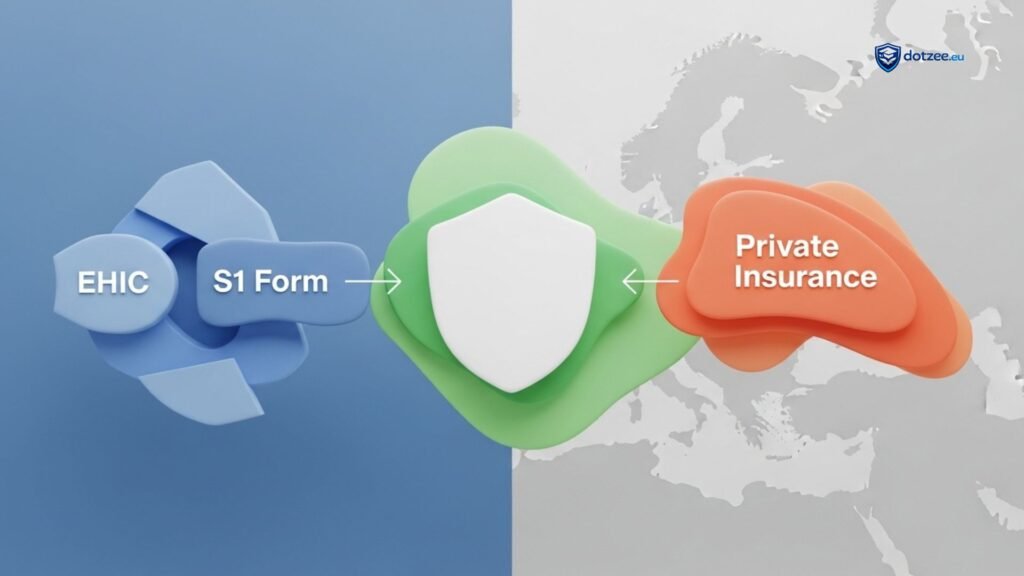
These three options are not really alternatives to each other, but serve different purposes. 🎯
First, the EHIC only gives you access to essential and emergency public healthcare during a temporary stay — it is not a comprehensive cover, nor does it cover private clinics, repatriation or every non-emergency situation. 🏥
On the other hand, the S1 form is a powerful tool: if you are resident in Latvia but insured in another EU/EEA country, Switzerland or the UK, then after registering the S1 you can receive the same public healthcare benefits in Latvia as locals — although this only works if the form is properly registered with the local NHS, especially for students staying longer. It can be a means of registering a family doctor and better access to outpatient facilities. 📋
And third, private health insurance is a practical safety net that not only meets immigration requirements, but also covers medical needs beyond the EHIC’s limits, such as specific medications, private facilities, or repatriation to your home country — so for non-European students or long-term residents, going without private cover is simply taking a risk. 🛡️
In short: the EHIC is temporary emergency cover, the S1 provides full government cover in certain cross-border cases, and private insurance ensures both your immigration compliance and practical protection. ✅
The mistakes that student applicants make the most ❌
I am writing this part based on my niche experience, because this is where even a paper-complete application practically fails.
Mistake number 1: Mistaking C visa insurance for long-stay student insurance
A cheap Schengen policy was taken, coverage came out to EUR 30,000, the applicant thought it was done. But in the case of a long-term student, the official threshold is EUR 42,600. The result? Had to buy a policy again, wasted time, and stress.
Mistake number 2: If you have an EHIC, then you don’t need anything else
This is an incomplete idea. EHIC is useful, but it is not enough for repatriation, private care, and some long-term needs. Universities also give broader guidance for this reason.
Mistake number 3: Not matching the policy duration with the stay duration
Admission is for one academic year, policy is for six months. Later, the renewal was missed. This small technical error can cause problems with both immigration and enrollment.
Mistake No. 4: “Treatment will be free in Europe”
According to the Latvian NHS, EHIC holders also receive treatment on the same conditions, and some services may have a patient contribution. That is, “state-funded” does not mean “zero cost” in every case.
How to use insurance in practice after arriving in Latvia? 🏙️
This section is often missed by articles, but the truth is that knowing how to use it is more important than buying insurance.
What to do in case of an emergency?
In Latvia, the emergency medical service is called 113, and if there is no SIM card in the phone or there is a specific situation, 112 is also available. This is 24/7. 🆘
Where to get general information?
The National Health Service’s informative line is available at 80001234 (within Latvia) and +371 67045005 (for foreign calls). This line is useful for state-paid services, patient contributions and procedure-related questions. Working hours are Monday–Thursday 8:30–17:00 and Friday 8:30–15:00.
What if a family doctor is not available?
According to the NHS, the family doctor consultative phone number 66016001 is available for advice on working days, evenings and weekends/holidays. This number is particularly useful for students as not every problem is an ambulance-level emergency.
Practical tip: Keep receipts and documents handy
Here is my strong advice:
- policy certificate
- passport/ID copy
- residence document copy
- insurer emergency contact
- medical receipts
- diagnosis/report
- prescriptions
Keep all of these in both digital and printed form. In Europe, claims problems are often less about “not getting treatment” and more about “not having documents complete”.
My practical checklist when choosing insurance 📝

This section, if you print it out and keep it with you, will eliminate a lot of confusion.
If you are a non-EU student
- Minimum liability EUR 42,600 or above 💶
- Latvia valid
- Better Schengen valid
- Repatriation written
- Hospital emergency treatment cover
- Policy valid for the entire stay or at least the initial legal stay period
- English certificate available
If you are an EU/EEA student
- Carry EHIC
- But see if you also need a broader private policy
- If long stay, explore S1 eligibility
- Don’t ignore institution-specific guidance
If you are applying from Pakistan
- Don’t just buy a policy on the advice of a consultant
- Read the wording yourself
- Check emergency assistance number
- See deductible/extra payment clauses
- Understand chronic condition exclusions
- And confirm that Latvia or Schengen area is clearly mentioned on the certificate
My honest recommendation: Which setup is the most sensible? 🎯
If I had to give a category-wise straight advice to the readers of dotzee.eu, I would say this:
Degree student from Pakistan or another non-EU country
Take out broad private health insurance that meets the official long-stay requirements. Don’t play with minimum cover; wording is clear, repatriation, Latvia validity, and preferably Schengen cover as well. This is the safest route.
EU student coming for one semester or Erasmus
Take an EHIC, but don’t consider it “complete cover”. If the budget allows, take out a supplemental private policy, especially if travel plans are extensive or you want to avoid uncertainty in non-acute care access.
Student insured in another EU/EEA country for long stay
Don’t ignore the S1 option. Many students are not aware of it, although with the right eligibility it can significantly improve healthcare access in Latvia.
Final takeaway 🎁
If I were to sum up this whole topic in a practical summary, it would be this:
👉 Student health insurance in Latvia is not “one-size-fits-all”.
👉 The EHIC is useful but limited.
👉 The S1 is powerful but not for everyone.
👉 Private insurance is of almost central importance for non-EU and long-stay students.
👉 And official threshold, wording, validity and repatriation are four pillars that cannot be ignored.
I always follow one rule when writing insurance content on dotzee.eu: something that does not work at the time of claim is not called protection. The same rule applies in the case of student insurance in Latvia. A document compliant, medically usable and practically understandable policy is the real better policy.
FAQ: Health Insurance for Students in Latvia ❓
Is health insurance mandatory for students in Latvia?
Yes, valid health insurance is practically and often legally required for international students, especially when the case is linked to a long-term visa or residence permit. University guidance also considers it mandatory.
What should be the minimum insurance coverage for a Latvian student residence permit?
According to official Latvian migration guidance, the minimum liability limit in the D visa or residence permit context should be EUR 42,600.
Is a Schengen policy with EUR 30,000 sufficient?
This minimum may only be relevant in some C visa / short-stay cases. In long-stay student cases it is often not sufficient, as the requirement for a D visa or residence permit is higher.
Should EU students also take out private insurance?
In many cases yes, at least as a practical backup. Especially when there is a long stay, the university advises broader cover, or you want to avoid the limits of the EHIC.
What is the S1 form and who is it useful for?
If you live in Latvia but are insured in another EU/EEA country, Switzerland or the UK, you can register for an S1 and receive state-funded healthcare in Latvia like local insured persons.
What is the emergency number in Latvia?
For a medical emergency, call 113. In some cases, 112 can also be used.
What is the official help line for health services in Latvia?
The NHS informative line is 80001234 (within Latvia) and +371 67045005 (for calls abroad).
What should a student from Pakistan to Latvia check first when buying a policy?
First, check that the policy has EUR 42,600+ cover, Latvia validity, repatriation, emergency hospital care, and clear English wording. This basic screening saves a lot of future problems.
Disclaimer: This article is for informational purposes only and does not constitute legal or insurance advice. Always verify requirements with official Latvian authorities.
Pingback: Insurance Coverage for Speech Therapy/Logopedie/Orthophonie for Students in Europe:
Pingback: Insurance for Students Renting Private Apartments in Europe: A Complete Guide