

If you’ve searched for Student insurance arbitration service Europe on Google, you’re probably going through a problem that can’t be solved by just “reading the policy”. This problem is quite common with students studying in Europe: sometimes a health claim gets rejected, sometimes a travel insurance claim gets delayed, sometimes money isn’t returned for a stolen laptop, and sometimes the insurer says “it wasn’t covered”.
Going to court is not always the first step for student insurance disputes in Europe. In many cases, out-of-court complaint routes like FIN-NET and ECC-Net are used first. This is the practical route that most people miss.
At dotzee.eu, we explain insurance topics in a simple but accurate way so that students, parents and expat families really understand what the next step should be after a claim is rejected. In this article, I will explain to you in a very clear way what FIN-NET is, what ECC-Net is, when each service is useful, and what is the correct way to file a complaint.
❓ What is a student insurance dispute in Europe?
A student insurance dispute does not simply mean a “claim rejection”. The real problem arises when your policy and the insurer’s interpretation clash.
These insurance categories are generally important for students in Europe:
- 🏥 Health insurance / medical cover
- ✈️ Travel insurance
- ⚖️ Personal liability insurance
- 🛋️ Contents insurance
- 💻 Laptop, phone or gadget cover
- 🚑 Accident insurance
- 🏠 Accommodation or rental related cover
🔁 Common disputes that I see repeatedly in practice
- Medical claim rejection
e.g. emergency treatment was done, but the insurer said it was a “pre-existing condition”. - Late claim payment
Despite submitting documents, the insurer withholds payment for months. - Dispute over deductible or excess
You think the insurer has deducted too much, but it shows the policy wording. - Loss/theft claim rejected
Student’s laptop was stolen, but claim rejected due to incomplete police report or proof. - Cross-border policy dispute
Policy was purchased from one EU country, student is studying in another country, and the claim process gets confusing.
The most important thing here is that insurance disputes are often decided on documentation, not emotions.
A student who keeps his receipts, medical reports, email trail and police report safe, has a much better chance of making a strong case.
🧭 What is FIN-NET and how does it work in student insurance?
FIN-NET’s full name is Financial Dispute Resolution Network. In simple words, it is a cooperation network for cross-border disputes of financial services at the European level.
📌 What is the main function of FIN-NET?
FIN-NET does not judge your case itself.
This will direct you to the correct national out-of-court complaint body. For example:
- Dispute with insurer
- Problem with bank/financial service
- Cross-border financial complaint
- Claim against registered service provider in EU/EEA country
✅ When is FIN-NET useful for student insurance?
If your insurance policy:
- Is taken out with an insurer registered in another EU/EEA country
- The claim is not being settled
- The insurer has not helped after a written complaint
- You are a student in one country and the insurer is in another
Then FIN-NET may be relevant
🧠 Practical benefits of FIN-NET
In my experience, the biggest problem in student cases is not who is right, but where to file a complaint.
FIN-NET reduces this confusion. It shows you the correct route, so that you don’t end up going to the wrong department.
📘 An example
Suppose you are a Pakistani student, studying in Germany, and you have taken travel insurance from a Netherlands-based company. Your medical claim is rejected.
Now if the company comes under a cross-border EU setup, FIN-NET can take you to the relevant ADR or ombudsman body in that country.
🛡️ What is ECC-Net and what is it for?
🧾 If you are a student in Europe and you have an insurance problem, such as a cross-border insurance policy, a delay in coverage, or a claim rejection, you don’t need to worry. 🎓
There are two main networks for protecting consumer rights in the European Union: ECC-Net (European Consumer Centres Network) and FIN-NET (Financial Services Network).
ECC-Net offers you free guidance on cross-border purchases, online policies, or disputes with an insurer based in another European country — whether you need to understand what your European consumer rights are, what language to file a complaint in, or what to write to the insurer first.
On the other hand, if the problem is purely related to financial services, FIN-NET connects you to the relevant national arbitration or complaint bodies.
Both networks offer practical, step-by-step help, saving you unnecessary legal complications: listing documents, identifying the right institution, and trying to reach an informal resolution.
So, whether your insurance problem is due to a language barrier or unclear rights, ECC-Net and FIN-NET can be your first, free and reliable step. ✅
⚖️ What is the real difference between FIN-NET and ECC-Net?
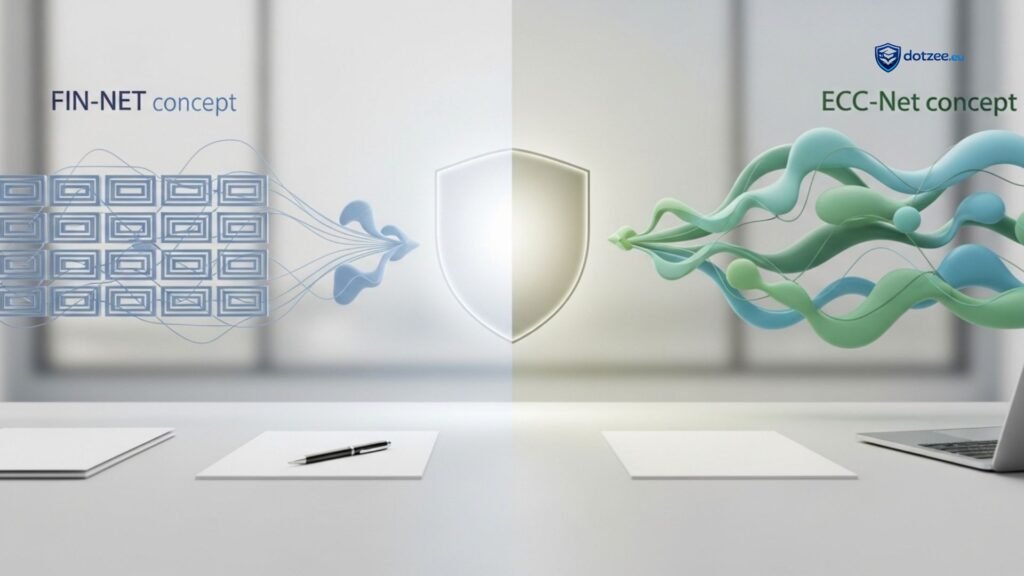
There is often confusion here, so I am giving a direct comparison.
| Aspects | FIN-NET | ECC-Net |
|---|---|---|
| Basic functions | Financial services cross-border disputes | Cross-border consumer complaints |
| Benefits in student insurance | Dispute against insurer / financial service provider | Consumer rights, complaint guidance, communication help |
| Does it decide itself? | No | No |
| Purpose | To direct the complaint to the right ADR/ombudsman | Guidance and informal help |
| Cost | Usually free | Usually free |
| Best used when | The insurer is in another EU/EEA country | There is a cross-border consumer issue and guidance is needed |
🗣️ Plain language to understand
- FIN-NET = financial services complaint channel
- ECC-Net = consumer complaint and guidance channel
In many cases one of the two is more appropriate, and in some cases ECC-Net will refer you to FIN-NET or the local ombudsman.
🥇 What should be the first step if a student insurance claim is rejected?
This is where most students make mistakes.
It is natural to feel angry when a claim is rejected, but a practical step-by-step approach is more beneficial.
1️⃣ Ask the insurer for a written reason
Instead of arguing over a phone call, ask for a clear reason in an email.
Verbal statements are not proven later, but a written explanation is very useful.
2️⃣ Reread the policy wording
Often the problem lies in a small clause of the policy:
- pre-existing condition
- waiting period
- deductible
- excluded sport
- delayed reporting
- incomplete documents
3️⃣ Gather evidence
Save the following items as per your case:
policy copy, premium payment proof, claim form, hospital report, doctor prescriptions, police report, flight ticket / booking proof, email correspondence, screenshots, receipts.
4️⃣ Use the insurer’s internal complaint process
Most companies have an internal complaint channel first.
Do not skip this step, as the ombudsman or network will look at this record later.
5️⃣ Wait for the final response
In many disputes, the insurer’s final response letter is very important.
After this, the next escalation step becomes stronger.
6️⃣ If the case is cross-border, look at FIN-NET or ECC-Net
If the insurer or service provider is in another EU/EEA country, then these networks may be a practical route for you.
🧩 In which situations is FIN-NET more suitable?
If your insurance issue is of a cross-border nature, such as a financial service, FIN-NET provides more suitable guidance for you. 🧾
For example, if your insurer is registered in another European country while you are resident in another, or if there are unnecessary delays in claim settlement, the insurer is being strict about interpreting policy terms, there is a dispute over refund or cancellation charges, or your complaint is not being resolved satisfactorily at the local level — then FIN-NET will connect you with the relevant national arbitration or Alternative Dispute Resolution (ADR) bodies in all such cases.
It is important to note that FIN-NET is not a court itself that will issue a decision, but rather acts as a bridge that will take you to the correct and competent body.
Therefore, if you feel that your problem is related to insurance financial services and extends across borders, contacting FIN-NET may be a wise step to save you time and energy. ✅
🤝 In what situations might ECC-Net be a better choice?
ECC-Net is usually useful when the case is of the consumer dispute type, for example:
- Policy purchased online cross-border
- There is a language issue
- It is difficult to reach the trader/insurer
- You need to understand EU consumer rights
- You need help drafting a complaint
🧠 A practical strength of ECC-Net
ECC-Net is very useful when the student does not know:
“In which country should I file a complaint?”
This question is common, especially among international students.
And the truth is that if the direction of the complaint is wrong, the whole case slows down.
📝 The correct way to file a complaint in Europe
If you are a student and the claim dispute is cross-border, then follow this sequence:
✅ Step 1: Prepare a basic record
- Policy number
- Date of incident
- Amount claimed
- Insurer’s response
- Short summary of loss
✅ Step 2: Write a simple but clear complaint draft
Do not use complex language in complaints.
Write this down:
- What happened?
- What are you asking for?
- What did the insurer reject?
- What supporting documents do you have?
✅ Step 3: Use the local complaint route
The ombudsman or ADR system may be different in each country.
✅ Step 4: Get cross-border help
If the provider is in another EU/EEA country, FIN-NET or ECC-Net may be relevant.
✅ Step 5: Track follow-up
Save each email, note deadlines, and create a timeline.
🔍 Why is an authoritative source important?
In an insurance dispute, people often rely on social media advice, which is dangerous.
It is always best to check the latest and official information, especially when the case is cross-border.
If you want to see the official overview, the European Commission’s FIN-NET information is available here:
European Commission — FIN-NET
The advantage of looking at the official source is that you know what kind of disputes the network handles, and what the complaint route is.
Similarly, it is wise to look at the official site of ECC-Net, especially when understanding the consumer-rights angle.
Special advice for Pakistani students

Pakistani students studying in Germany, France, Italy, Spain, Poland, Netherlands or other European countries often make the same two mistakes:
1️⃣ Taking insurance documents lightly
The biggest mistake is to download the policy PDF and forget it.
2️⃣ Late incident reporting
Not reporting immediately after a loss/theft/medical issue can weaken a claim.
3️⃣ Mistaking EHIC for full private insurance
This is a very common confusion.
The European Health Insurance Card (EHIC) and private student insurance are not the same thing.
EHIC helps in some medical situations, but it does not replace every claim.
4️⃣ Relying on screenshots
Screenshots are useful, but receipts, email threads and official documents are stronger.
5️⃣ Thinking “the company said it, so it’s over”
No.
If there is a written response, it can be challenged, especially if the wording is ambiguous or the evidence is stronger.
🧠 Why do we consider this topic important at dotzee.eu?
The real purpose of insurance is not just to sell a policy, but to provide practical protection in times of problem.
That’s why at dotzee.eu we cover topics that give the reader real-world action, not just theory.
The most valuable thing in student insurance disputes is that you:
- Understand your rights
- Handle the evidence
- Choose the right complaint route
- Recognize the direction of FIN-NET or ECC-Net in a cross-border case
This knowledge is especially useful when the student is in a foreign country, there is a language barrier, and the family is worried in Pakistan.
❓ FAQ: Student Insurance Arbitration Service Europe, FIN-NET, ECC-Net
1) What is FIN-NET?
FIN-NET is a European network that helps cross-border financial disputes reach the right out-of-court complaint body.
2) What is ECC-Net?
ECC-Net is the European Consumer Centres Network that helps cross-border consumer complaints and rights guidance.
3) Does FIN-NET decide my claim itself?
No, FIN-NET does not decide itself. It refers you to the relevant national ADR or ombudsman.
4) Can ECC-Net help with insurance disputes?
Yes, if the problem is a cross-border consumer issue, ECC-Net can provide guidance, mediation support and complaint direction.
5) Are these services free?
Generally yes, these services are available to consumers free of charge or at a very low cost.
6) Is it necessary to go to court if a student insurance claim is rejected?
No, it is better to first look at the insurer’s internal complaint, then ADR/ombudsman, and in cross-border cases FIN-NET or ECC-Net.
7) What documents are needed to file a complaint?
Policy copy, proof of payment, claim form, correspondence, medical or police reports, receipts and final response letter.
8) Can non-EU students also use these complaint routes?
In most cases yes, if the dispute is with an EU/EEA-based provider and the contract is cross-border.
Disclaimer: This article is for informational purposes only and does not constitute legal or insurance advice. Always verify requirements.



Pingback: How to Get Retroactive Approval in Student Insurance? Complete Guide